
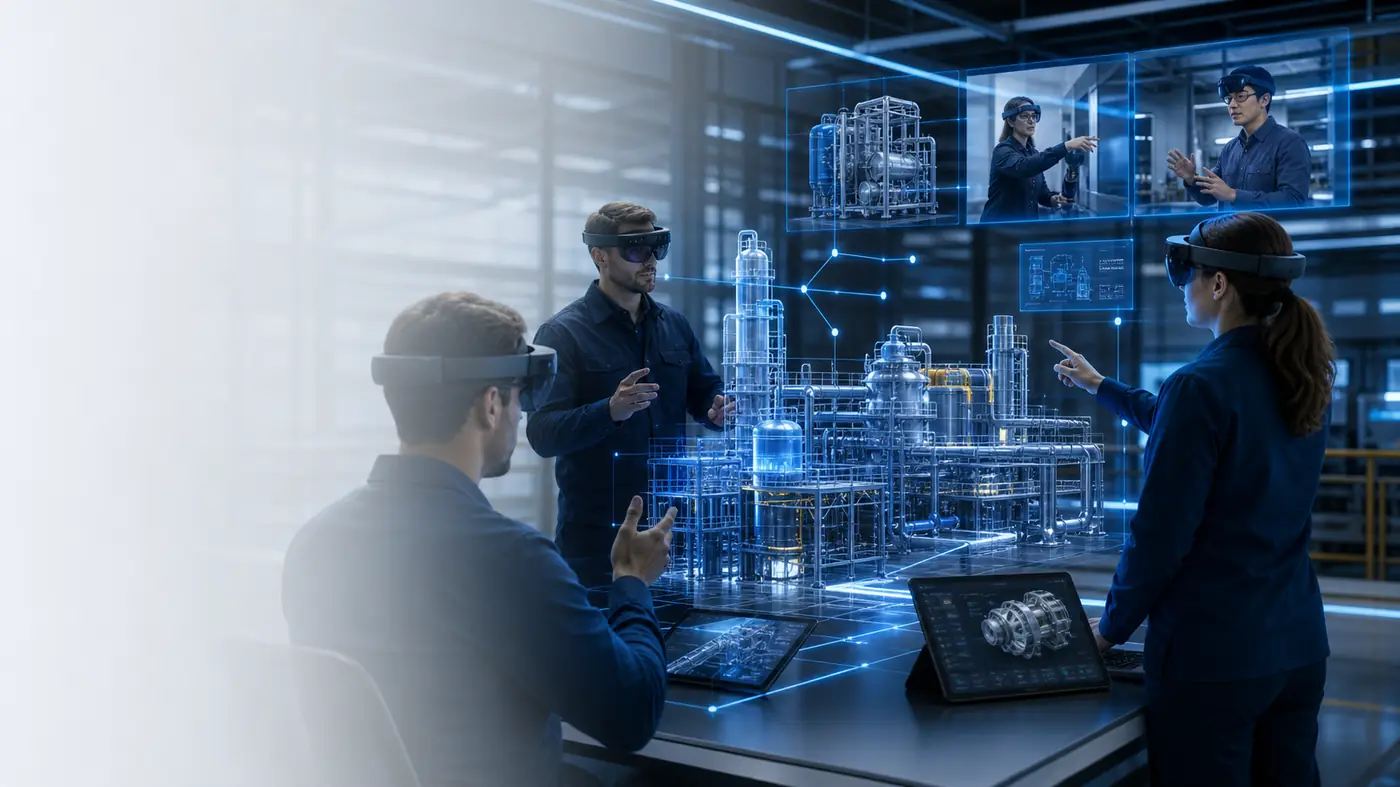
The Problem This Solves
XR projects often fail because they start as impressive demos instead of operational tools. The visuals may be strong, but the content pipeline is fragile, device constraints are underestimated, tracking quality varies, and the experience does not connect to training, maintenance, collaboration, or analytics workflows.
Enterprise spatial computing needs more than a headset app. It needs 3D asset preparation, spatial anchors, interaction design, device deployment, identity, content updates, performance optimization, and a clear reason users would choose the spatial interface over a screen, PDF, or video call.
How Vertex Builds It
Vertex starts with the job to be done: what the user must learn, inspect, rehearse, compare, or decide. We map that workflow into spatial interactions, content requirements, device capabilities, and operational constraints. The right solution may be mixed reality, VR, AR on mobile, or a 3D web experience.
We then design the production pipeline: 3D model optimization, digital twin data flow, spatial alignment, collaboration features, analytics, and content governance. The experience is built around usability and maintainability, not novelty.
Where It Fits
Industrial training simulations for complex equipment and safety procedures.
Remote expert collaboration with spatial annotations and shared context.
Digital twin visualization for plants, buildings, products, or field assets.
Maintenance guidance with step-by-step overlays and asset context.
Architecture & Delivery Flow
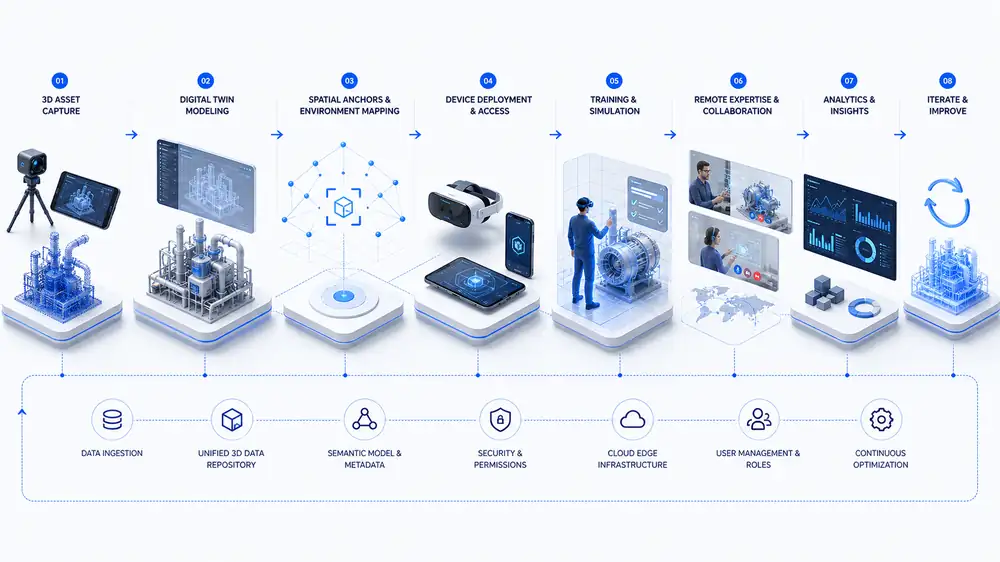
The delivery flow is intentionally practical: validate the business case, identify the riskiest technical assumptions, build the smallest useful production path, and then harden the operating model so the system can be owned after launch.
Expected Outcomes
Shorter training cycles through immersive, repeatable scenarios.
Better field accuracy because instructions align with physical context.
Reduced travel and downtime through remote expert collaboration.
Improved stakeholder understanding of complex assets and systems.
Reusable 3D pipelines that support updates instead of one-off demos.
Frequently Asked Questions
Should we build for headsets, mobile AR, or web 3D?
That depends on the workflow, environment, content complexity, and user adoption path. Vertex evaluates device fit before recommending an implementation stack.
Can existing CAD or 3D assets be reused?
Often yes, but they usually need optimization, format conversion, material cleanup, and level-of-detail planning before they perform well in XR.
How do you measure XR success?
We measure outcomes such as training completion, error reduction, time-to-task, collaboration efficiency, retention, and operational adoption.
Can XR connect to live enterprise data?
Yes. Spatial interfaces can connect to digital twin data, IoT telemetry, asset systems, training records, and collaboration tools.