

The Problem This Solves
Agentic AI is powerful because it can act across systems, but that is also the risk. A useful agent may read documents, call APIs, update records, draft messages, run analysis, and request approvals. If the orchestration is vague, the system becomes hard to debug, unsafe to delegate, and difficult for business owners to trust.
Many agent prototypes over-index on autonomy and under-invest in control. They lack clear task boundaries, tool permissions, state management, observability, test coverage, and escalation paths. The result is a workflow that can impress in a demo but fails when edge cases, compliance, or operational accountability matter.
How Vertex Builds It
Vertex begins by decomposing the target workflow into decisions, tools, data dependencies, approval points, and failure modes. We decide what should be deterministic software, what should be model-assisted, what needs human review, and what should never be delegated.
We then build the orchestration layer: agent roles, tool registry, prompt and state management, retry behavior, memory policy, audit logging, monitoring, and evaluation. Frameworks such as LangGraph or CrewAI may be used where they fit, but the architecture is driven by workflow control rather than framework novelty.
Where It Fits
Operations copilots that coordinate internal tools and summarize action paths.
Research agents that gather, compare, and structure evidence from approved sources.
Customer service workflows that draft, classify, escalate, and update systems.
Back-office automation for finance, compliance, procurement, and reporting.
Architecture & Delivery Flow
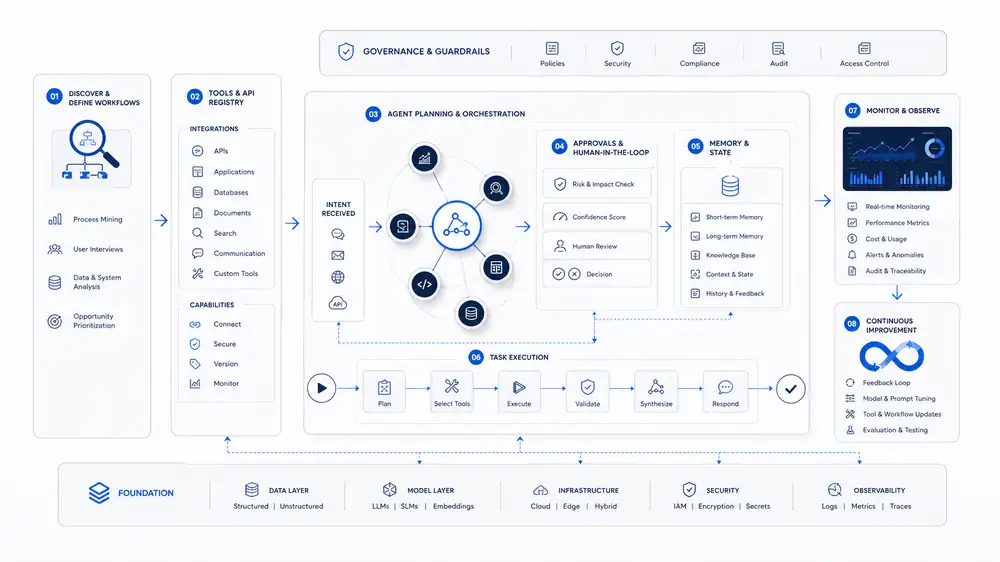
The delivery flow is intentionally practical: validate the business case, identify the riskiest technical assumptions, build the smallest useful production path, and then harden the operating model so the system can be owned after launch.
Expected Outcomes
Less manual coordination across fragmented tools and teams.
More reliable automation through scoped tools, approvals, and recoverable state.
Better auditability because agent actions, reasoning traces, and outputs are logged.
Faster iteration because workflows can be evaluated and improved step by step.
Reduced operational risk through explicit autonomy limits and escalation paths.
Frequently Asked Questions
What makes a workflow a good fit for agentic AI?
Good candidates involve repeated multi-step work, context gathering, tool use, and judgment. Poor candidates require guaranteed deterministic behavior without ambiguity.
How do you prevent agents from taking risky actions?
We scope tool permissions, define approval gates, log actions, isolate high-risk operations, and add policy checks before sensitive steps.
Do agents replace workflow software?
Usually no. Agents work best when they coordinate existing systems and fill judgment-heavy gaps around established workflows.
Can agent behavior be tested?
Yes. We build scenario tests, tool-call checks, expected-output evaluations, and monitoring so agent releases can be compared over time.